
In today’s competitive digital landscape, guesswork is expensive. Whether you’re running paid ads, email campaigns, or organic marketing, understanding how users move through your sales funnel is critical. Analytics transforms raw data into actionable insights — helping you identify bottlenecks, improve conversions, and maximize ROI.
If you want better results without increasing your marketing budget, optimizing your funnel through analytics is the smartest place to start.
What Is a Sales Funnel?
A sales funnel represents the journey a customer takes from first discovering your brand to making a purchase (and ideally becoming a repeat customer). It typically includes:
- Awareness – Visitors discover your brand.
- Interest – They explore your website or offers.
- Consideration – They compare, evaluate, and engage.
- Conversion – They make a purchase or complete a goal.
- Retention – They return or refer others.
Each stage requires different messaging, strategies, and optimization techniques — and analytics helps you understand what’s working and what isn’t.
Why Analytics Is Essential for Funnel Optimization
Without analytics, you’re guessing. With analytics, you can:
- Track user behavior in real time
- Identify drop-off points
- Measure campaign performance
- Improve targeting
- Increase conversions
- Reduce acquisition costs
Tools like Google Analytics and Hotjar allow businesses to monitor how users interact with their websites, providing data that supports smarter decisions.
Step 1: Identify Where Users Drop Off
One of the biggest benefits of analytics is spotting leaks in your funnel.
Ask:
- Are visitors leaving on the landing page?
- Are they abandoning the checkout?
- Are they not clicking your CTA?
Using funnel visualization reports in Google Analytics, you can see exactly where users exit. If 60% of users abandon at checkout, you know where to focus improvements — perhaps simplifying forms, reducing friction, or offering multiple payment options.
Step 2: Track the Right Metrics at Each Stage
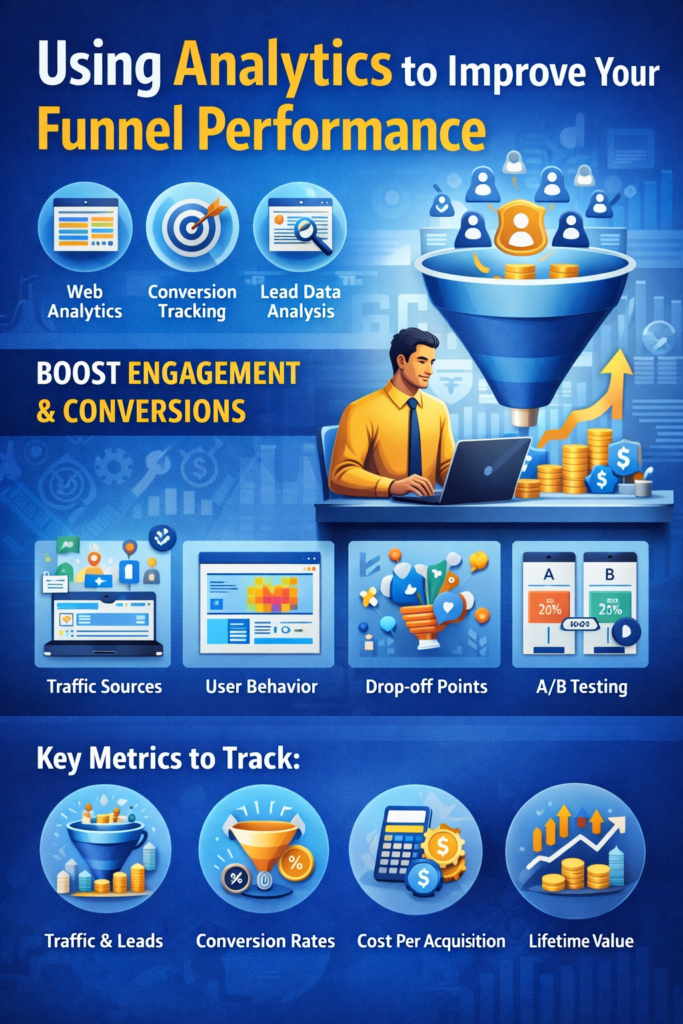
Different funnel stages require different KPIs:
Awareness Stage
- Traffic sources
- Impressions
- Click-through rate (CTR)
Consideration Stage
- Time on page
- Bounce rate
- Pages per session
Conversion Stage
- Conversion rate
- Cost per acquisition (CPA)
- Cart abandonment rate
By aligning metrics with funnel stages, you avoid focusing on vanity metrics and instead prioritize performance indicators that impact revenue.
Step 3: Use Heatmaps and Session Recordings
Understanding numbers is important — but understanding behavior is even better.
Tools like Hotjar provide:
- Heatmaps (where users click most)
- Scroll tracking (how far they scroll)
- Session recordings (real user journeys)
If users aren’t scrolling to your CTA, the issue may be placement — not messaging. Small layout changes can significantly boost conversions.
Step 4: Segment Your Audience
Not all users behave the same.
Segment by:
- Traffic source (organic, paid, social)
- Device (mobile vs desktop)
- Location
- New vs returning users
For example, if mobile users convert 40% less than desktop users, your mobile UX likely needs optimization.
Segmentation helps you tailor improvements instead of applying generic fixes.
Step 5: A/B Test Everything
Analytics tells you what is happening. A/B testing tells you why.
Test:
- Headlines
- CTA buttons
- Landing page layouts
- Pricing displays
- Images vs videos
Even minor changes — like changing “Buy Now” to “Get Started Today” — can influence conversion rates.
Use data to guide decisions rather than relying on assumptions.
Step 6: Optimize for Retention, Not Just Conversion
Many businesses stop optimizing once a sale happens. But repeat customers are more profitable than new ones.
Track:
- Repeat purchase rate
- Customer lifetime value (CLV)
- Email engagement
Analytics can show you which customers are likely to return — and help you create remarketing strategies to increase long-term revenue.
Common Funnel Mistakes to Avoid
- Tracking too many irrelevant metrics
- Ignoring mobile performance
- Not setting up conversion goals properly
- Failing to test after making changes
- Making decisions based on small sample sizes
Data is powerful — but only when interpreted correctly.
Turning Insights Into Revenue
Improving funnel performance is not about increasing traffic. It’s about improving the percentage of visitors who convert.
When you:
- Fix drop-off points
- Simplify user journeys
- Personalize experiences
- Continuously test and optimize
You create a streamlined path from awareness to conversion — increasing profitability without increasing ad spend.
Final Thoughts
Analytics is not just about numbers — it’s about understanding people.
By using data strategically, you can identify weaknesses, optimize every stage of your funnel, and turn more visitors into paying customers. Businesses that rely on data consistently outperform those that rely on assumptions.