
In today’s competitive digital landscape, attracting customers is no longer just about running ads or posting on social media. Businesses that consistently generate leads and sales follow a structured approach known as a marketing funnel. But what exactly is a marketing funnel, and why is it essential for your business growth?
Let’s break it down.
What Is a Marketing Funnel?
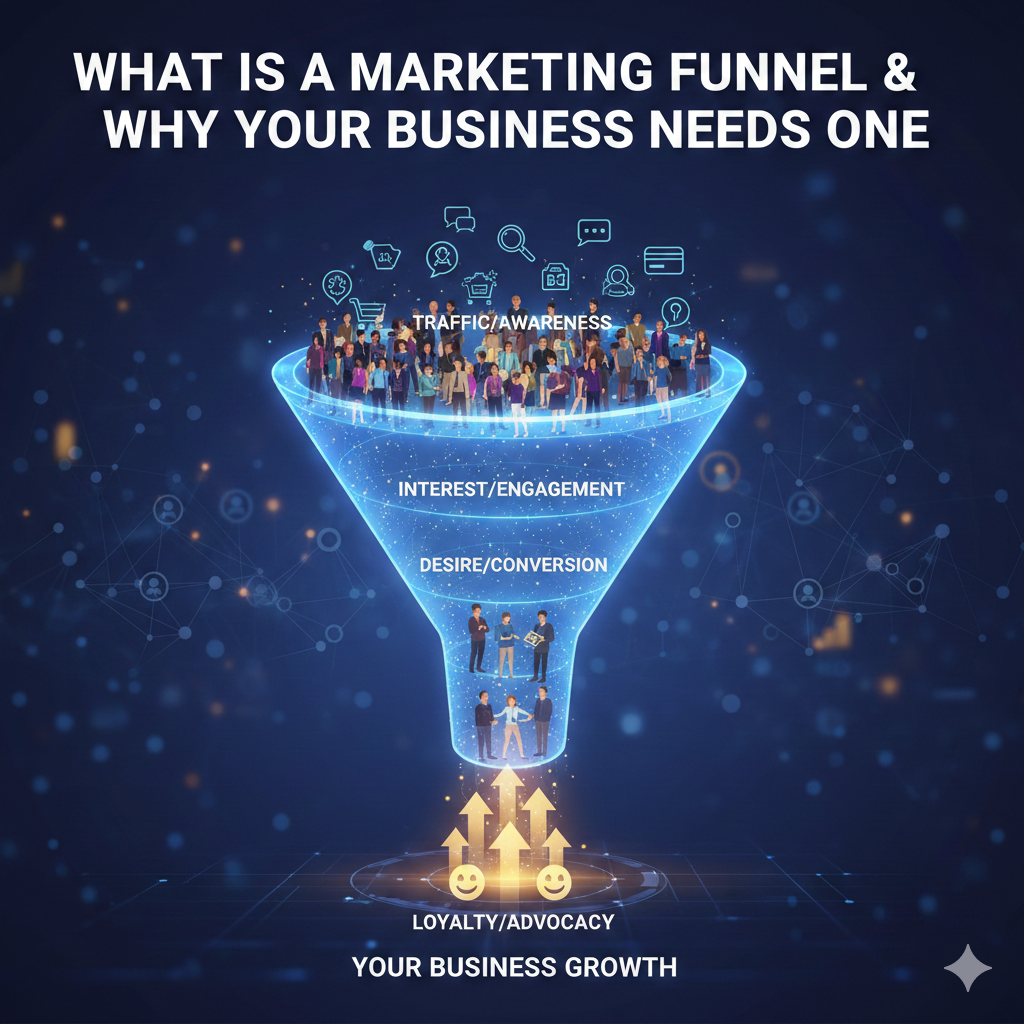
A marketing funnel is a step-by-step framework that maps the customer journey—from the first interaction with your brand to the final purchase and beyond. It helps businesses understand how prospects think, behave, and make decisions at each stage.
The funnel is called a “funnel” because:
- Many people enter at the top (awareness)
- Fewer move to consideration
- Even fewer convert into paying customers
A well-optimized funnel ensures no potential customer is lost due to confusion, lack of trust, or poor communication.
The Key Stages of a Marketing Funnel
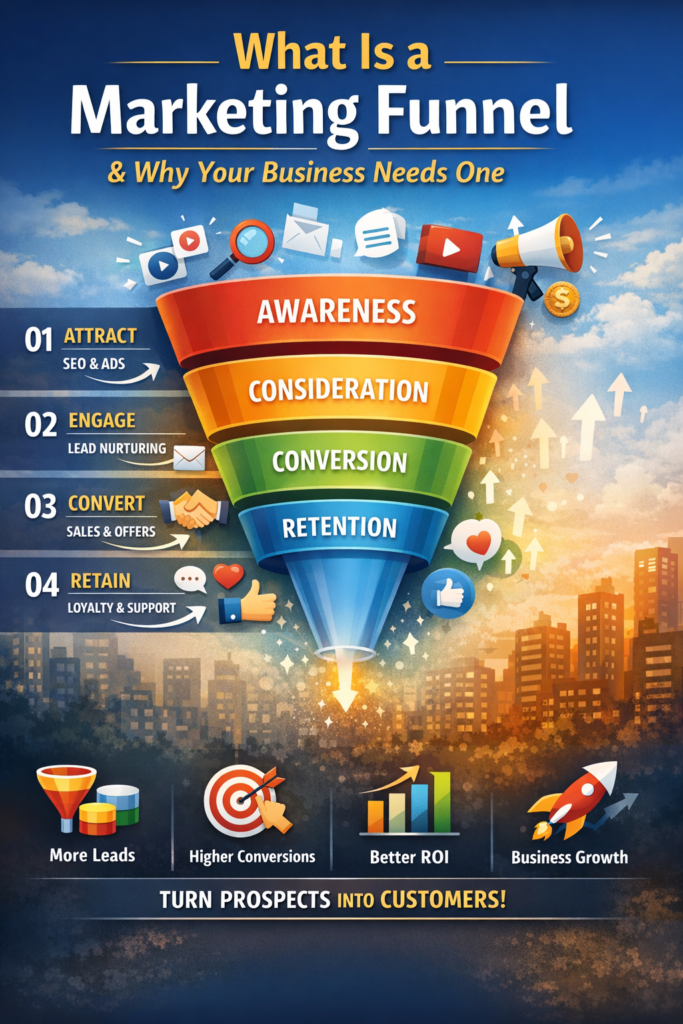
1. Awareness (Top of the Funnel – TOFU)
This is where potential customers first discover your business.
Examples:
- Google search results
- Social media posts
- Blog articles
- Online ads
- Word of mouth
Goal:
Create visibility and educate your audience about a problem or need.
Marketing Tools Used:
- SEO blogs
- Social media marketing
- Paid ads
- Brand campaigns
2. Interest & Consideration (Middle of the Funnel – MOFU)
At this stage, users are aware of your brand and are actively comparing solutions.
Examples:
- Reading service pages
- Downloading guides or case studies
- Subscribing to newsletters
- Watching explainer videos
Goal:
Build trust and show why your solution is better.
Marketing Tools Used:
- Email marketing
- Lead magnets
- Webinars
- Testimonials
- Product comparisons
3. Conversion (Bottom of the Funnel – BOFU)
This is where prospects take action and become customers.
Examples:
- Booking a consultation
- Making a purchase
- Signing a contract
- Requesting a quote
Goal:
Remove objections and make conversion easy.
Marketing Tools Used:
- Landing pages
- CRM automation
- Limited-time offers
- Clear CTAs (Call-to-Actions)
4. Retention & Loyalty (Post-Funnel)
The funnel doesn’t stop at conversion. Retaining customers is more cost-effective than acquiring new ones.
Examples:
- Follow-up emails
- Loyalty programs
- Upselling and cross-selling
- Customer support
Goal:
Turn customers into repeat buyers and brand advocates.
Why Your Business Needs a Marketing Funnel
1. Predictable Lead Generation
A funnel creates a consistent flow of qualified leads, rather than relying on random marketing efforts.
2. Higher Conversion Rates
By delivering the right message at the right time, funnels reduce friction and increase the likelihood of conversions.
3. Better Customer Understanding
Funnels help you analyze:
- Where users drop off
- What content performs best
- Which channels bring high-quality leads
4. Efficient Use of Marketing Budget
Instead of wasting money on broad advertising, a funnel focuses spending on users who are most likely to convert.
5. Scalable Business Growth
Once a funnel is optimized, it can be automated and scaled—allowing your business to grow without increasing costs proportionally.
Examples of Marketing Funnels for Businesses
- Service Businesses: Blog → Free consultation → Proposal → Contract
- E-commerce: Social ad → Product page → Checkout → Email follow-up
- Real Estate: Listing ad → Property inquiry → Site visit → Deal closure
- B2B Companies: LinkedIn ad → Case study → Sales call → Long-term client
How to Build an Effective Marketing Funnel
- Define your target audience
- Identify customer pain points
- Create content for each funnel stage
- Use automation tools (CRM, email workflows)
- Track performance and optimize continuously
Final Thoughts
A marketing funnel is not a luxury—it’s a necessity for any business that wants sustainable growth. Whether you’re a startup, service provider, or established brand, having a clear funnel helps you attract the right audience, convert more leads, and build long-term customer relationships.
If your business doesn’t have a marketing funnel yet, you’re leaving revenue on the table.